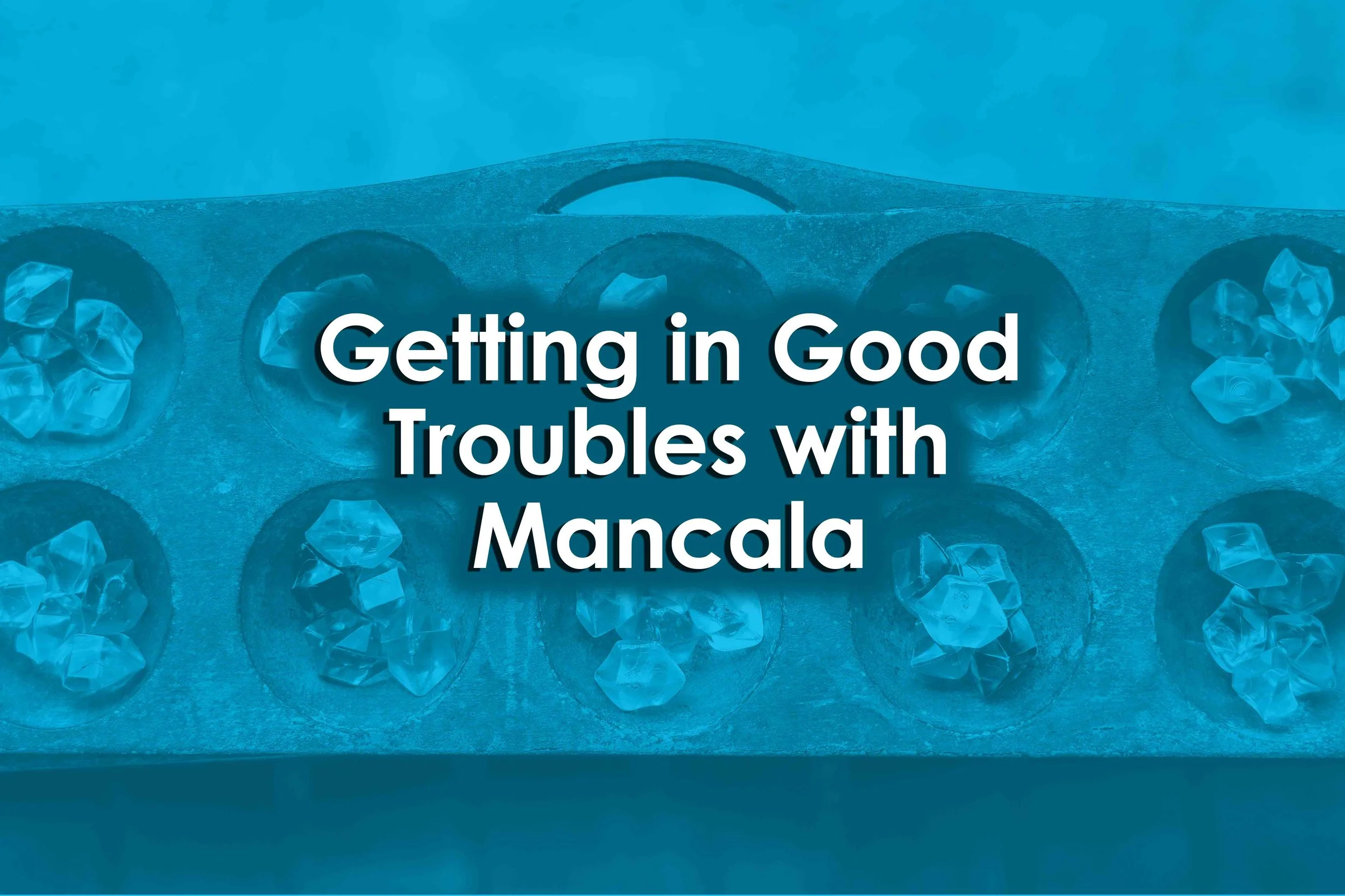
This paper discusses the term “mancala “and the implication of its use as a generic term for all classic African board games with holes, and seeds. We textually analyzed recent literature on classic African board games; we address the use of “mancala” in the literature.
Read MoreA University of Georgia study shows that well-designed video games can effectively support elementary science learning. Researchers developed Virtual Vet, a game where students act as vet assistants caring for two cats, to teach anatomy, health, and scientific reasoning.
Read MoreThe article Revolutionizing Education: How Gaming Transforms the Classroom discusses how gaming is increasingly integrated into education to enhance traditional learning. It highlights competitive video games, coding platforms, and simulations as tools that improve critical thinking, collaboration, and real-world problem-solving.
Read MoreWhen Will Coleman was diagnosed with Type 1 diabetes at 17, he and his family struggled to find age-appropriate tools for managing the disease. This inspired his mother, Northeastern professor Leanne Chukoskie, and her Ph.D. student Sundararaman Rengarajan to develop Sugar Slay, an app that uses gamification and biometric tracking to help young adults manage glucose levels.
Read MoreThe video game industry’s rapid growth has intensified efforts to protect gameplay innovations through patents, a practice that has long sparked controversy over breadth and innovation constraints. Recent patent activity by Nintendo and Electronic Arts highlights this tension. Nintendo has secured multiple U.S. patents covering core Pokémon-related gameplay mechanics...
Read MoreThe Becker School of Design & Technology hosted the two-day Games for Good Conference, highlighting how “serious” games can drive social impact, education, and cultural understanding. Drawing more than 350 attendees and featuring over 80 presentations, the conference explored topics such as climate awareness, neurodiversity, health, education, and intercultural empathy through game design.
Read MoreA new meta-analysis reveals that just ten minutes of playing number board games can significantly enhance early math skills in young children. Led by researchers from the University of Oregon, the study analyzed 18 research efforts across preschool to second grade, finding strong evidence that such games improve counting, number recognition, and understanding of quantity.
Read MoreBrittany Westlund, a third-year graduate student in the University of Montana’s online MFA in Game Design and Interactive Media, is emerging as an innovative game designer, educator, and community builder. Living in Kalispell, she balances coursework, teaching online classes, launching Charmlab Studio, and creating emotionally driven games.
Read MoreGreat game design is an art that blends psychology, creativity, and technical skill to create engaging player experiences. Captivating games rely on understanding player behavior, balancing challenge and reward, and fostering emotional connections through well-timed feedback and immersive worlds. Effective design uses simple mechanics that deepen over time...
Read MoreDr Michael J. Dillon and Prof Laura Bowater explore how gamified learning can transform biomedical education by moving beyond passive lectures toward active, social, and experiential learning. As biomedical knowledge grows in complexity, gamification—through serious games and structural game elements—offers a way to improve engagement, understanding, and retention.
Read MoreBoard games and casual mobile games succeed by making the first action clear, feedback immediate, and return effortless. Simple mechanics reduce entry barriers without removing depth. Tables add social guidance, while phones rely on intuitive design. Both formats must respect players’ time, sustain attention, and make the next move feel worthwhile.
Read MoreA lung cancer surgeon has collaborated with the makers of Minecraft and the Ruth Strauss Foundation to create an educational game that helps children understand cancer and challenges its taboo status. The free UK school resource, Detect & Diagnose, places players in the role of a medical student exploring hospital departments, meeting patients, and learning how cancer...
Read MoreAWS BuilderCards is a strategic card game created by AWS Solutions Architect David Heidt to teach cloud computing concepts through play. Inspired by a misunderstanding of “battle cards,” the game translates AWS’s extensive service portfolio into accessible, educational mechanics that balance complexity and ease of learning.
Read MoreCognitive resilience refers to the ability to remain calm, adapt, and make effective decisions under stress, uncertainty, and information overload. Traditional training methods, based on predictable scenarios and fixed procedures, are increasingly inadequate for today’s complex crises.
Read MoreThis article argues that probability and risk are taught most effectively through high-stakes simulations rather than abstract formulas. Using roulette, slots, baccarat, blackjack, and corporate war games, it shows how learners experience expected value, variance, combinatorics, conditional probability, Bayesian updating, and tail risk in practical settings.
Read MoreOver the past 20 years, UCF’s Florida Interactive Entertainment Academy (FIEA) has graduated more than 1,000 alumni prepared for careers in the growing $450 billion gaming industry and beyond. While many work for major entertainment companies, others apply game design skills to “serious gaming” fields such as military and defense training.
Read MoreEducational games flourished from the late eighteenth to nineteenth centuries, reflecting new ideas about learning through play. Although women were largely excluded from formal education, educational games offered them creative and intellectual opportunities.
Read MoreThe article describes how clinical pharmacy specialists Deborah Booth and Allison Tempo use gamification to improve disaster preparedness education for pharmacists. They created a PowerPoint-based virtual escape room incorporating quizzes, puzzles, and cultural references to teach emergency management concepts.
Read MoreThe article highlights Dakota State University math professor Justin Schroeder, who combines mathematics, probability, and board game design to engage students and players. Inspired by childhood dice-based simulations, Schroeder created and published two games, Seventh Inning Stretch and Storybook Saga, which blend chance, strategy, and mathematical reasoning.
Read MoreSomething Something Soup Something is an interactive game set in 2078 where players act as servers deciding what qualifies as soup for humans, while aliens cook increasingly strange meals. Players must judge items such as batteries in liquid, rocks with garnishes, or frozen substances, choosing whether they are “soup” or “not soup.”
Read More