

Episode 175 Suzanne Lyons on Cooperative Games
Suzanne Lyons on Cooperative Games
Episode Summary:
This episode of Experience Points features Suzanne Lyons, an educator, author, game designer, and founder of CooperativeGames.com who has championed cooperative games in education since 2009. Suzanne recounts discovering cooperative games at a nature education conference, taking over Animal Town, one of the earliest makers of cooperative board games in America, and learning from pioneers such as Terry Orlick and Jim Deacove of Family Pastimes. Drawing on Alfie Kohn's No Contest and Morton Deutsch's theory of social interdependence, she explains why competition deserves critical examination. Suzanne offers three answers to the alpha player problem - game mechanics that divide information, resources, and roles among players; explicit framing from the teacher; and open access games such as Fortunately, Unfortunately, Line Up, and Highlights, where no single player can simply find the solution. Suzanne closes by explaining why academic learning depends on social-emotional learning and classroom climate, and why cooperative games are a practical and underused way to support both.
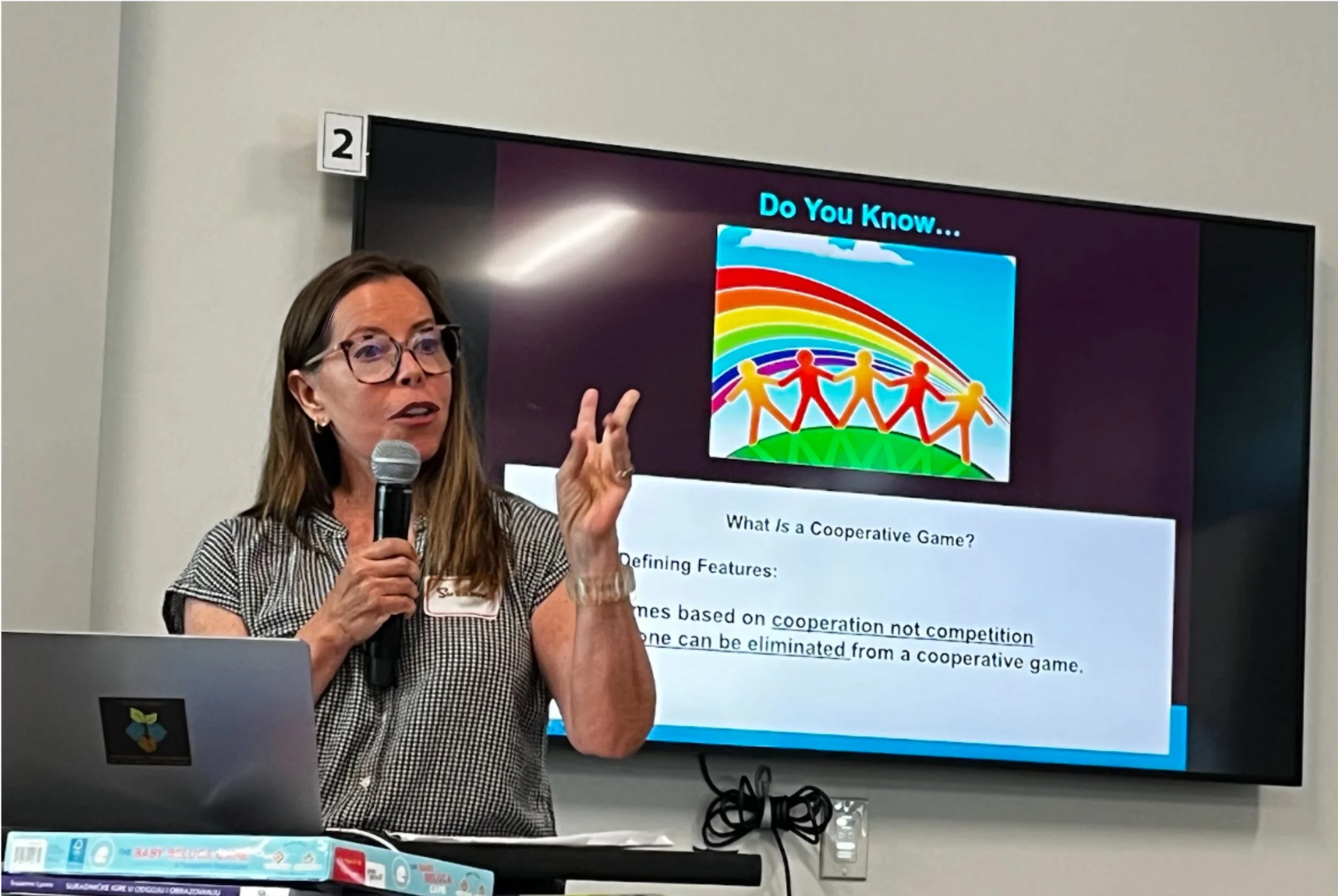
Suzanne Lyons
she/her/hers
Educator, Author, Game Designer, Entrepreneur
CooperativeGames.com - Arcata, CA USA
Suzanne Lyons is an educator, author, game designer, and founder of CooperativeGames.com. She began her career teaching physics and general science, then moved into textbook writing and curriculum development. She co-authored the textbook Conceptual Integrated Science with renowned physics educator Paul Hewitt. She learned about cooperative games in 2009 at a nature education conference, when cooperative games were still relatively unknown. Since then, she has been an active advocate and researcher in the field, writing books including Cooperative Games in Education (Teachers College Press). She also created the award-winning Baby Beluga Game in collaboration with children's singer Raffi. Her degrees are in physics (UC Berkeley), earth science (Sacramento State University), and education (Stanford University). She currently provides professional development and conducts research on the many benefits and uses of cooperative games across the curriculum.
(LinkedIn): https://www.linkedin.com/in/hellosuzannelyons
(Website): https://www.cooperativegames.com
[Dave Eng] (0:00 - 1:05)
Hi and welcome to Experience Points by University XP. On Experience Points, we explore different ways we can learn from games. I'm your host Dave Eng from games-based learning by University XP.
Find out more at www.universityxp.com. On today's episode, we'll learn from Suzanne Lyons. Suzanne is an educator, author, game designer, and founder of CooperativeGames.com.
A former physics and general science teacher and university lecturer in math education, she co-authored Conceptual Integrated Science with renowned educator Paul Hewitt before becoming a leading advocate for cooperative games in education. She's the author of Cooperative Games in Education, creator of the award-winning Baby Beluga Game with children's singer Raffi, and now works with schools, universities, and educational organizations to help teachers use cooperative games to strengthen academic learning while building classroom communities where students feel supported, connected, and ready to participate.
Suzanne, welcome to the show.
[Suzanne Lyons] (1:06 - 1:09)
Hi, Dave. Thanks for inviting me. And hi to everybody who's listening.
[Dave Eng] (1:10 - 1:36)
Great. Thank you, Suzanne. Glad to have you here. Really excited to talk more about your work with cooperative games. So, I want to start off with my first question, which is discovering cooperative games in general. I know when we had discussed via email, you first encountered cooperative games at a nature education conference in 2009. So my question is, what did you learn about them then? And why did you devote so much of your career to studying and sharing them?
[Suzanne Lyons] (1:38 - 8:50)
Right. Yeah, basically, I learned that cooperative games exist at that conference. It was a totally new concept to me that people could play games without competition. This was 2009. The idea was not in wide circulation. And I thought it was just a delightful idea.
At that time, as you had mentioned, I had already been a science educator for some years teaching physics and general science and earth science. And I had finished co-authoring this integrated science textbook, big project. And I therefore knew a lot about how to explain science.
But I was looking, hunting around for more innovative methods that were more student-centered. And so, there was a person from the Netherlands, Anne Mijke van Harten, who ran Earth Games. She knew all about cooperative games and was using them for nature education.
I thought it would be a fantastic strategy for teaching science and especially climate change because the games model collective action. So, the students could be learning the science information through the game narrative at the same time that they would be practicing cooperative skills and getting into the cooperative mindset that in real life, we really do need to tackle collective action problems and solve our great challenges of the day. So, after the conference, I was thoroughly excited and intent on finding out more about cooperative games.
And surprisingly, I learned that Ken and Jann Kolsbun, who owned a small company called Animal Town that made the first cooperative board games in America, live near me. So we connected and long story short, I ended up taking over Animal Town, buying it because yeah, they were ready to retire. And I was ready to get started.
So there I was kind of an accidental entrepreneur. And through them, I got immersed in sort of a small community of people who were working with cooperative games and had been sort of the first wave of cooperative games in the 70s, 80s and 90s. A lot of educators.
And I'm talking about people who, people like Terry Orlick, a professor in Canada, kinesiology professor who had written Cooperative Games and Sports, really the first book about cooperative games for educators. Fabulous to this day. Also Jim Deacove of Family Pastimes - that company and his great games.
He was apparently the first person to create cooperative board games. So I was becoming, learning about this in a very sort of intimate way, knowing the characters involved and seeing where they were coming from. And then I read everything I could find.
I read, of course, Alfie Kohn's No Contest: The Case Against Competition, which was a rigorous and thorough examination of competition as a social phenomenon. I learned about the literature and the research, the theory of social interdependence, Deutsch, et cetera, where we learned that the social effects of competition are significant and indeed concerning. Certainly in schools and in society at large, we take competition as sort of an ethos, as if it's always great.
And we don't really examine it. And people are generally unaware of the social hazards that are connected with it. So all of this ferment was part of my early days with cooperative games.
As I was running the company, my little company, CooperativeGames.com, I was attracting people to that who were very interested. And some were knowledgeable already about cooperative games. I was hearing from teachers and counselors, et cetera.
And now I realized, oh, my goodness, this isn't just about modeling cooperative situations and solving problems together. The real secret sauce of cooperative games is their social-emotional impact. And so teachers were using these games to really help kids out there and to, again, just to attend to the affective side of the student and to build classroom climate.
So from all of this, I started creating things myself. I did write the Cooperative - my first book was The Cooperative Games Bullying Prevention Program based on some great research, 1994, University of Nevada study about cooperative games increasing pro-social behavior in young children and also profoundly decreasing aggression measurably. So, I wrote that, I wrote a book about that.
And so, it was kind of amazing. The principal researcher for that study endorsed the book and Alfie Kohn endorsed the book and Raffi read it and endorsed the book. And the next thing I know, oh, my gosh, you know, like Raffi and I are saying we have to create a game.
So, we did, and I designed it and produced it all 100% sustainably through my little company. And that's The Baby Beluga Game. And then next thing that happened was I had the opportunity to write a more academic book, very pedagogy focused for Teachers College Press.
That book was published in 2022. It's called Cooperative Games in Education. So here we are now interested in sort of examining and certainly disseminating the practice of using cooperative games in education and doing it very intentionally.
There are teachers that know about cooperative games, but this whole phenomenon has, it was studied and there was research done in that early phase I was mentioning with Terry Orlick, but it faded from view. And so what we're trying to do now, what I'm personally especially interested in is picking up on all the original wisdom and research and practice of cooperative games in the early days in the humanistic era of education and connecting that with what is happening in the educational sphere today so that we use the games in a very timely way and still capture some of that magic that was described in those early days of cooperative games.
[Dave Eng] (8:50 - 10:32)
I see. Well, thank you, Suzanne. I appreciate you sharing your very comprehensive background.
And I really enjoy it when people share their origin story about how they first discover a particular area, like in this case, cooperative games or just applied games in general. Alfie Kohn is someone who I read. I've only read one of his works, Punished by Rewards, because it was shared to me by one of my colleagues, but it was a great book.
It really provided a counterpoint to, I think, a lot of the ways that I was thinking about using applied games and specifically like gamification for teaching and learning outcomes. And I'm glad that you've read Alfie's work. And although I've not read the other book that you had mentioned by him before, but to give the listeners some context here, I had originally contacted Suzanne because I wrote the article for University XP on What are Cooperative Games?
And I was going through my own academic journey for trying to determine how to define this for the particular article. And I think that one of the statements that I had written in the game, something I had shared with some of my other colleagues, is that my argument is that I believe that all games are actually cooperative games. I know that people will usually compare cooperative games to competitive games.
But my thesis here, as I like to tell them, is even with a competitive game, we all have to collaborate and cooperate and agree to the fact that we are going to be playing a competitive game. There are going to be rules to the game. And in order to fulfill the expectation for this game, which is a competitive outcome, we first have to cooperate and agree that these are the rules and we're going to follow them in order to have that experience.
I wanted to know, Suzanne, if you had thought about it like that or if you agree or disagree with my statement. I'd just kind of like to get your input and feedback on that.
[Suzanne Lyons] (10:33 - 12:45)
Oh, indeed. That's a great point. And I play pickleball, OK? I mean, you know, like I get out there and people are competing and I see competition. And indeed, yes, there's so much cooperation within any competitive scenario. Fun fact, I mentioned Terry Orlick as a founder of cooperative games.
He was also an Olympic coach. All right. So he got around the whole dilemma with advising Olympic athletes to focus on their personal best.
Competition becomes, it can be a slippery slope, is the real problem. And I think in cooperative games, we're trying to examine competition critically and thoroughly so that we're aware of what can happen when it gets out of hand and people are so motivated by the need to win that they will cheat, that they will not abide by rules of fair play that do apply and that guard a competitive situation and keep people from feeling desperate to win, which is when kind of the aggression begins, the resentment begins, lack of trust.
And we have all of the documented social effects. It's Morton Deutsch's theory of social interdependence. It's really bedrock social psychology.
And it is documented. And Alfie Kohn's book certainly goes into this in just great detail about how competition can really get out of control. So we need to be critical.
And part of that is highlighting the value of cooperation with cooperative games and offering a purely cooperative situation where the win is everybody wins. There's no loser. So that can kind of help us examine competition and get a little distance from it so that we use it wisely and also so that we really do focus on gaining cooperative skills.
[Dave Eng] (12:46 - 13:25)
Right. And that's a good point, Suzanne, because that leads me to my second question, which is as someone who plays a lot of tabletop games and board games, I have to say that I do own a significant number of cooperative games in my collection, although they are not the ones I turn to on a regular basis. But I think the criticism that I've shared or heard from in the community is that there's an issue with balancing voices.
So my second question is, how can a cooperative game prevent one confident player? Oftentimes we call this like the quarterback or the person that's like controlling the game narrative. How can a cooperative game prevent one confident player from controlling the group while quieter participants become passive or overlooked?
[Suzanne Lyons] (13:26 - 21:29)
OK, great question. And yes, I am very familiar with this problem. I think it's called the alpha player problem sometimes.
And so what I focus on is not as much games for entertainment in social settings, but I really do focus on using cooperative games in educational settings. So given just that focus, my answer is there's three ways that we control the alpha player problem. First one is with designing the games and using mechanics that mitigate that issue.
You are looking for basically equal or equitable participation so that everybody has the opportunity to participate as they want. So you do things like design the game so that information or resources are divided among the group. So everybody has some critical resource that needs to be shared or you can give different players different roles or you can require that consensus is reached.
I'm sure you probably know a lot about the mechanics for mitigating the alpha player problem. But if we're talking about educational settings, then there is a teacher who is the facilitator. And the teacher can just be explicit in framing the game so that the students are very well aware that the goal is for everybody to participate and that this is not the moment to try to save the group yourself or solve the problem yourself.
This is really about what can we do as a group. So just making that explicit is going to undermine assumptions they probably have because we all are in a very competitive environment and we're used to games that are competitive and all that. So make it explicit that that's not what we're going for.
But here's the third key to balancing voice participation, which is actually really, really interesting to me. And I think to you, this is the idea that really there's a distinction between two different kinds of cooperative games. Some of them, like I think the tabletop ones that we're mentioning, like Save the Whales from Animal Town or all these board games, they pose a problem or a puzzle that require developing a strategy to solve.
So the group has to figure out an optimal solution and win and those games can be wonderful. But they are the ones that are more vulnerable to the alpha player problem. The most analytically skilled or assertive person could take over.
The other type of game, there is no primary, there's no purpose, there's no goal to solve a problem or find a solution. The purpose of these games is just to co-create a fun experience of cooperation. Now we're into the realm of a lot of games that were used in those earlier days in the sort of humanistic era of education in the 70s through 90s.
Terry Orlick's got a lot of them. These are games where the purpose is just to have fun and enjoy one another. I'll give you an example.
Fortunately, Unfortunately, it's a cooperative storytelling game. And so one child adds a fortunate event to the story and the next will, on their turn, will add an unfortunate event and around you go.
Like player one might say, unfortunately - they're inventing this story - when a man crossed the street, he stepped on a banana peel. And then player two might say, well, fortunately, he didn't actually slip when he stepped on that peel. And then player three might say, well, unfortunately, he skated on the peel all the way across the street.
And now they're starting to laugh and everything. And player four could say, well, there were no cars on the street at that time. But player five might say, unfortunately, the man crashed into an ice cream cart parked along the curb.
But then, of course, player six could say, fortunately, the man crashed into an ice cream cone and got to taste the best ice cream he ever had. So, you know, it's just fun. It's just fun.
Line Up is another basic template that can be adapted. I've used it in my university classes teaching future math teachers. You can use it for kindergartners.
Basically, it's just you've got your group of people, give them a card with some information on it. And the group sequences themselves without talking in a progression from beginning to end or top to bottom or first to last or whatever. So like for my math kids, they're not kids, math adults, learning adults, I would give them all a card with an interesting number on it.
Maybe, you know, some integers, but curious things, too, like a factorial or infinity or pi or a cube root or things like this. So there's some thought about math. They're thinking about math while they're doing this, but they're also just like stumbling around and sort of like figuring out what the sequence is.
And it's just very enjoyable. And no single person has the opportunity to just find a solution. Terry Orlick's game Highlights, the simplest game in the world.
People sit in a circle and share highlights from their day. Like, again, this is adaptable. When I teach teachers, I use this game.
It just has a transformative effect on the mood of the group. You know, tell me something that made you happy that happened so far today. OK, everybody goes around.
So see how equitable and how just geared toward sharing the human experience these games are. It's interesting to see them at work. It's more effective than you might imagine when you've got people in a classroom, heterogeneous classrooms, and we're talking about children.
You know, you want opportunities that don't sort people into the so-called best, right? And the losers. No, you want people to feel comfortable with who they are and to be seen and appreciated for who they are.
So I think that's - and by the way, that study about games that prevented aggression and evoked pro-social skills. If you look at the games that were used, a lot of them are the kinds of games that I'm talking about here. So I think it's really profound.
I think that we should, as we all get interested in cooperative games in education, it's this kind of issue that we can probe and refine and learn about. But yeah, so your question has, I think, three answers. We deal with the problem with dealing with the mechanics of a game.
We look at a classroom management issue where the teacher instructs the students to cooperate. And then thirdly, we look for these kinds of games, let's call them open access games, where dominance or being the first or being the best is just not going to be relevant.
[Dave Eng] (21:29 - 22:12)
Yeah. All right. Thanks, Suzanne.
Anecdotally, a lot of what you said resonated with me because this past weekend I had shared - my wife and I go away every year with a group of friends and we rent a house together. We just spend some time together. And they always know me as the person that brings the games.
And that's the person, like I fulfilled that role now for many years. And I've just kind of slowly shifted over to playing more cooperative games because I feel that it is the types of games. And again, it's not for learning.
This is just for fun and entertainment. It's the types of games that really work with the vibe of our group. And we played a game this past week called Just One.
Are you familiar with that tabletop game?
[Suzanne Lyons] (22:12 - 22:14)
No, I'm not. OK.
[Dave Eng] (22:14 - 23:55)
So just to give you a brief overview and to tell the listeners who have not played it before, it's a cooperative party game. It's based on words. It is using dry-erase markers.
And there's going to be one person that is the guesser. And they're going to have a card with five words on it. And everyone else is playing to help the guesser guess that word on the card.
It's usually just nouns like banana or a sunscreen or umbrella or something else like that. And then everyone else has a little whiteboard and they have a dry-erase marker. And everyone has to write just one word on their whiteboard in secret.
So everyone's working individually. And then while the guesser is looking away, everyone that writes clues reveals their whiteboard at the same time. And this is the interesting choice moment.
Everyone reveals their whiteboards. Anyone that wrote the same word has to erase their whiteboard. So the guesser does not get the benefit of that clue.
And then all the remaining clues get shown to the guesser. And then the guesser has to try to guess that word. It's a fun game because it is very much a game about playing to the strengths of the guesser.
But I also realized after playing it a bunch of times now that it has a very interesting spectrum of clues too because you don't always want to write the obvious clues for umbrella like rain or something because you probably will duplicate someone else. So you want to choose clues that are a little bit more esoteric. But if everyone chooses esoteric clues, then the guesser has no idea what all these words mean or how they relate to each other.
And it was a very fun experience. And a bunch of people in the group were asking, this is great, but how do we win? How long do we play for?
And I just said, it's more of an activity than a game. Like, yes, you can play it to determine a score and determine how well we cooperated. But I also told them, I'm just fine playing this until we're tired and we want to go to sleep.
[Suzanne Lyons] (23:55 - 23:55)
Yeah, there you go.
[Dave Eng] (23:56 - 24:02)
And that can be an experience on its own. It doesn't always need to be competitive. It can be just that.
And that's fine.
[Suzanne Lyons] (24:03 - 24:48)
It's just fine. It's still a game. It's still a form of play.
It's fun. There are rules. And you have a certain goal, but it's kind of an open-ended goal in a lot of cases.
So it really makes for just a really good time. And you can express yourself freely. And I love it for social situations.
Compare that to some of these more competitive situations where there can be undercurrents that you can feel. So yeah.
[Dave Eng] (24:49 - 25:20)
Great. That leads me into my third and last question. Overall, for the podcast and for all of these interviews, I'm always looking for good applications.
So this last question is about learning through cooperation. So I know that educators can use games to teach academic content, like you had illustrated before, and as we often discuss. Your work does that, but it also emphasizes using games to cultivate classroom climate and foster social and emotional development.
So my question for you, Suzanne, is how and why do you use cooperative games to do both?
[Suzanne Lyons] (25:22 - 29:28)
Well, I use cooperative games to do both, because both of these need to be done. Whenever we're teaching academic content, I believe we have to also be aware of and craft our teaching to accommodate the social-emotional needs of the student and the classroom climate itself. I just, you know, I think that there's just so much research by now demonstrating that academic learning depends on social-emotional learning and the climate of the classroom.
Some of us math and science teachers often can focus on the sort of rational, analytic, cognitive component of, because the subject matter is very linear and logical, so that might seem like something you could do, but the reality is that, you know, you've got a classroom full of people who are, it's a social environment, there's group dynamics at play, and any of the students that are having blocks or, you know, things that are distracting them in those social-emotional spheres, they're not going to have their mind free to focus on the academic content. So you really, you know, and boy, we have a lot of classes, a lot of students in our classes that really do have very, very significant social-emotional problems that they're coping with. So to make everybody ready to learn and, you know, to connect with each other, to create an environment that feels safe and feels supportive, we're going to have to do both, teach both academic and be aware and have methods for social-emotional education as well.
So given that we're going to have to do that, why choose cooperative games? Well, games are great. Everybody loves them.
They're easy to implement. You have an endless, you know, variety of games that you can choose from, invent, craft yourself, adapt to your classroom. And they're just so, they're just so practical in that way.
So choose games. And while we're going to choose games, let's think cooperative games, because we are dealing with, you know, a competitive situation in the classroom that can really become very, oh, you know, it can just prevent people from feeling comfortable. They're not necessarily in a relationship where they're allies.
They're, you know, working to be the best. They're told they need to be the best so often. So the cooperative games help us establish norms of cooperation.
And as we're saying, you know, when the games are being played, kids, you know, they practice sharing, they practice their communication, they start to behave kindly toward one another and to help one another. And so you get all of these fabulous benefits on top of just the practical benefits of using games. So, you know, the practical, they support academic learning by supporting social-emotional development.
They can certainly be combined with academic learning like we're talking about. I love using games that teach both math and get the social-emotional learning in there at the same time, for example. So it's just an opportunity.
It's a modality that has not in any way gotten its due. And so the opportunity is here and we should just go for it.
[Dave Eng] (29:29 - 29:47)
Great. Thank you, Suzanne. I think that's a really good point to end on is choose games and choose cooperative games.
So thank you for providing that insight to other educators. Unfortunately, we're at the end of our time. Again, Suzanne, thanks for joining us today.
I learned, certainly I learned a lot from you. Where can other people go to find out more about you online?
[Suzanne Lyons] (29:48 - 29:57)
Go to CooperativeGames.com and you can email me, suzanne@cooperativegames.com. And I'd love to hear from people.
[Dave Eng] (29:58 - 30:03)
Excellent. I'll include those links to your website and also your email address in the show notes. So thank you, Suzanne.
[Suzanne Lyons] (30:03 - 30:04)
Thank you.
[Dave Eng] (30:05 - 30:59)
I hope you found this episode useful. If you'd like to learn more, then a great place to start is with my free course on gamification. You can sign up for it at www.universityxp.com/gamification. You can also get a full transcript of this episode, including links to references in the description or show notes.
Thanks for joining us. Again, I'm your host, Dave Eng from Games Based Learning by University XP. On Experience Points, we explore different ways we can learn from games.
So if you like this episode, please consider commenting, sharing, and subscribing. Subscribing is absolutely free and ensures that you'll get the next episode of Experience Points delivered directly to you. I'd also love it if you took some time to rate the show.
We live to lift others with learning. So if you found this episode useful, consider sharing it with someone who could also benefit. Also make sure to visit University XP online at www.universityxp.com. University XP is also on Twitter, Bluesky, Facebook, and LinkedIn as University XP.
Also feel free to email me anytime. My email address is dave@universityxp.com. Game on!
Cite this Episode
Eng, D. (Host). (2026, October 18). Suzanne Lyons on Cooperative Games. (No.175) [Audio podcast episode]. Experience Points. University XP. https://www.universityxp.com/podcast/175
Internal Ref: UXP1S46P7IFS
References
Bay-Hinitz, A. K., Peterson, R. F., & Quilitch, H. R. (1994). Cooperative games: A way to modify aggressive and cooperative behaviors in young children. Journal of Applied Behavior Analysis, 27(3), 435-446. https://doi.org/10.1901/jaba.1994.27-435
BoardGameGeek. (n.d.). Cooperative game [Board game mechanic]. Retrieved September 23, 2026, from https://boardgamegeek.com/boardgamemechanic/2023/cooperative-game
BoardGameGeek. (n.d.). Jann Kolsbun [Board game designer]. Retrieved September 28, 2026, from https://boardgamegeek.com/boardgamedesigner/9636/jann-kolsbun
BoardGameGeek. (n.d.). Jim Deacove [Board game designer]. Retrieved September 28, 2026, from https://boardgamegeek.com/boardgamedesigner/1121/jim-deacove
BoardGameGeek. (n.d.). Roles with asymmetric information [Board game mechanic]. Retrieved September 23, 2026, from https://boardgamegeek.com/boardgamemechanic/2892/roles-with-asymmetric-information
BoardGameGeek. (n.d.). Variable player powers [Board game mechanic]. Retrieved September 23, 2026, from https://boardgamegeek.com/boardgamemechanic/2015/variable-player-powers
Collaborative for Academic, Social, and Emotional Learning. (n.d.). What is the CASEL framework? Retrieved September 23, 2026, from https://casel.org/fundamentals-of-sel/what-is-the-casel-framework/
CooperativeGames.com. (n.d.). Bringing Animal Town games back. Retrieved September 23, 2026, from https://cooperativegames.com/about-cooperative-games/animal-town/
Deutsch, M. (1949). A theory of co-operation and competition. Human Relations, 2(2), 129-152. https://journals.sagepub.com/doi/10.1177/001872674900200204
Durand-Bush, N. (n.d.). In memoriam: Terry Orlick. Association for Applied Sport Psychology. Retrieved September 28, 2026, from https://appliedsportpsych.org/about/memorial-tributes/kate-f-hays-1/
Earth Games. (n.d.). Over Earth Games [About Earth Games]. Retrieved September 23, 2026, from https://www.earthgames.nl/over-earth-games/
Eng, D. (2019, September 26). Game theme. University XP. Retrieved September 23, 2026, from https://www.universityxp.com/blog/2019/9/26/game-theme
Eng, D. (2019, December 10). Decision space. University XP. Retrieved September 23, 2026, from https://www.universityxp.com/blog/2019/12/10/decision-space
Eng, D. (2020, January 9). Socializing games. University XP. Retrieved September 23, 2026, from https://www.universityxp.com/blog/2020/1/9/socializing-games
Eng, D. (2020, July 9). What is the magic circle? University XP. Retrieved September 23, 2026, from https://www.universityxp.com/blog/2020/7/9/what-is-the-magic-circle
Eng, D. (2020, July 30). What is the lusory attitude? University XP. Retrieved September 23, 2026, from https://www.universityxp.com/blog/2020/7/30/what-is-the-lusory-attitude
Eng, D. (2020, October 1). What makes a good rule book? University XP. Retrieved September 23, 2026, from https://www.universityxp.com/blog/2020/10/1/what-makes-a-good-rule-book
Eng, D. (2020, December 3). Game mechanics for learning. University XP. Retrieved September 23, 2026, from https://www.universityxp.com/blog/2020/12/3/game-mechanics-for-learning
Eng, D. (2021, July 27). How to teach someone to play a game. University XP. Retrieved September 23, 2026, from https://www.universityxp.com/blog/2021/7/27/how-to-teach-someone-to-play-a-game
Eng, D. (2021, October 26). Applied games-based learning. University XP. Retrieved September 23, 2026, from https://www.universityxp.com/blog/2021/10/26/applied-games-based-learning
Eng, D. (2022, September 27). What is strategy in gameplay? University XP. Retrieved September 23, 2026, from https://www.universityxp.com/blog/2022/9/27/what-is-strategy-in-gameplay
Eng, D. (2022, December 6). What are game goals and objectives? University XP. Retrieved September 23, 2026, from https://www.universityxp.com/blog/2022/12/6/what-are-game-goals-and-objectives
Eng, D. (2024, April 16). What is a game? University XP. Retrieved September 23, 2026, from https://www.universityxp.com/blog/2024/4/16/what-is-a-game
Eng, D. (2024, May 28). What are educational games? University XP. Retrieved September 23, 2026, from https://www.universityxp.com/blog/2024/5/28/what-are-educational-games
Eng, D. (2024, August 20). Game goals vs. learning outcomes. University XP. Retrieved September 23, 2026, from https://www.universityxp.com/blog/2024/8/20/game-goals-vs-learning-outcomes
Eng, D. (2024, November 19). Types of games. University XP. Retrieved September 23, 2026, from https://www.universityxp.com/blog/2024/11/19/types-of-games
Eng, D. (2026, March 12). What are cooperative games? University XP. Retrieved September 23, 2026, from https://www.universityxp.com/blog/2026/3/12/what-are-cooperative-games
Eng, D. (2026, August 23). Win conditions first [Audio podcast episode]. Experience Points. University XP. https://www.universityxp.com/podcast/171
Hewitt, P. G., Lyons, S. A., Suchocki, J. A., & Yeh, J. (2020). Conceptual integrated science (3rd ed.). Pearson. https://www.pearson.com/store/en-us/p/conceptual-integrated-science/P200000007010
Kohn, A. (1986). No contest: The case against competition. Houghton Mifflin. https://www.goodreads.com/book/show/111217.No_Contest
Kohn, A. (1993). Punished by rewards: The trouble with gold stars, incentive plans, A's, praise, and other bribes. Houghton Mifflin. https://www.goodreads.com/book/show/541132.Punished_by_Rewards
Kolsbun, K. (n.d.). Ken Kolsbun: Author and social change activist. Retrieved September 28, 2026, from https://peacesymbol.com/
Kolsbun, K., & Kolsbun, J. (1978). Save the Whales [Board game]. Animal Town Game Company. https://boardgamegeek.com/boardgame/19781/save-the-whales
Lyons, S. (2014, July 20). A brief history of cooperative games. CooperativeGames.com. https://cooperativegames.com/a-brief-history-of-cooperative-games/
Lyons, S. (2017). The cooperative games bullying prevention program: Cooperative games for a warm school climate pre-K to grade 2. Better World Education. https://cooperativegames.com/media/book-details
Lyons, S. (2018). The Baby Beluga Game [Board game]. CooperativeGames.com. https://www.cooperativegames.com/blog/meet-the-baby-beluga-game
Lyons, S. (2022). Cooperative games in education: Building community without competition, PreK-12. Teachers College Press. https://www.tcpress.com/products/cooperative-games-in-education_9780807780886
Orlick, T. (2006). Cooperative games and sports: Joyful activities for everyone (2nd ed.). Human Kinetics. https://www.abebooks.com/9780736057974/Cooperative-Games-Sports-Joyful-Activities-0736057978/plp
Positive Living Skills. (n.d.). Highlights. Retrieved September 28, 2026, from https://www.positivelivingskills.com.au/familylinkconcepts/highlights
Roudy, L., & Sautter, B. (2018). Just One [Board game]. Repos Production. https://boardgamegeek.com/boardgame/254640/just-one
Zagal, J. P., Rick, J., & Hsi, I. (2006). Collaborative games: Lessons learned from board games. Simulation & Gaming, 37(1), 24-40. https://doi.org/10.1177/1046878105282279