

Designing for Change: How Collaborative Games Teach, Transform, and Empower

Designing for Change: How Collaborative Games Teach, Transform, and Empower
Designing for Change:
How Collaborative Games Teach, Transform, and Empower
PAX East 2026
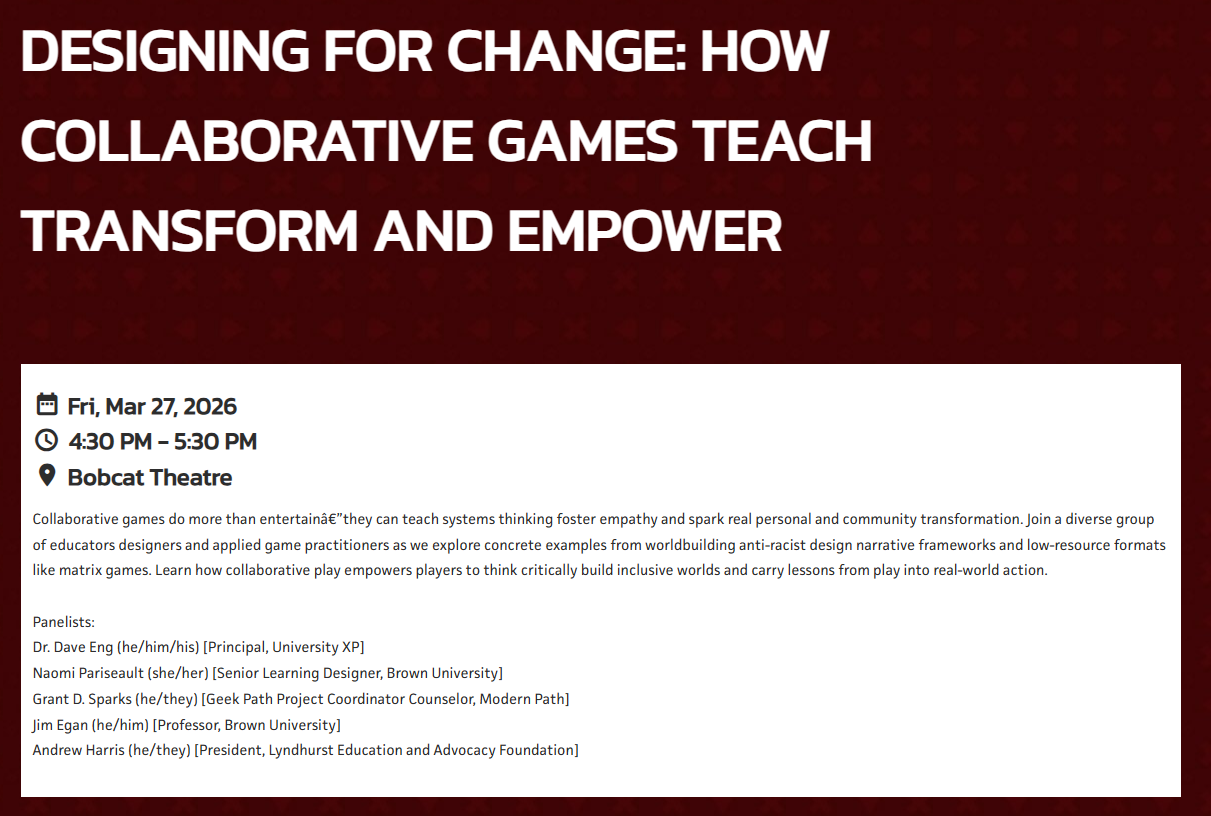
Date & Time: Friday, March 27, 2026 - 4:30 PM–5:30 PM (ET)
Location: Bobcat Theatre, PAX East, Boston, MA
Panel Overview
This session, “Designing for Change: How Collaborative Games Teach, Transform, and Empower,” explored how collaborative games can be used as tools for learning, empathy-building, and social transformation. The panel featured perspectives from higher education, counseling, and applied game design.
The discussion emphasized that collaborative games are not just entertainment - they are structured experiences that can shape how people think, relate to others, and engage with real-world systems.
Panelists
Dave Eng - Principal, University XP (Moderator)
Naomi Pariseault - Senior Learning Designer, Brown University
Grant D. Sparks - Counselor & Applied Game Practitioner, Modern Path
Jim Egan - Professor, Brown University
Andrew Harris - Game Designer & Educator, Lyndhurst Education and Advocacy Foundation (LEAF)
Session Summary
Defining Collaborative Games
Dave Eng opened the session by defining collaborative games as experiences where players work together toward a shared goal, emphasizing that success and failure are collective rather than individual. He noted that these games rely on communication, teamwork, and shared decision-making-not technical expertise.
This framing set the tone for the panel: collaborative games are accessible tools that can be used across disciplines without requiring participants to identify as “gamers.”
Where Collaborative Games Are Used
Each panelist grounded the discussion in their own practice:
Andrew Harris described using games in schools and museums to build social skills and community engagement.
Grant Sparks shared how collaborative games are used in counseling settings, both in private practice and outreach, to support emotional development and interpersonal learning.
Naomi Pariseault and Jim Egan discussed their work at Brown University, where games are integrated into undergraduate courses and extended to high school students through national programs.
Dave Eng added that he uses collaborative games in undergraduate education, cybersecurity training, and community-based “third spaces” through nonprofit initiatives.
Together, these examples illustrated the flexibility of collaborative games across educational, therapeutic, and informal environments.
Types of Change Facilitated by Games
When asked what kind of change they aim to support:
Andrew Harris focused on building social connection and confidence, particularly among youth.
Grant Sparks highlighted vulnerability and the importance of challenging social norms around emotional expression.
Naomi Pariseault emphasized helping learners see systems as changeable rather than fixed.
Jim Egan pointed to empathy and open-mindedness, especially in questioning rigid categories.
Dave Eng reflected on his shift toward advocating for games as tools beyond entertainment, including education, learning, and development.
Perspective-Shifting Moments in Gameplay
A central theme of the discussion was how collaborative games create moments that shift player perspectives.
Grant Sparks described a Minecraft-based group where participants gradually built a shared world, developing trust and collaboration over time.
Andrew Harris highlighted tabletop role-playing scenarios that introduced moral ambiguity, prompting players to reconsider assumptions.
Naomi Pariseault discussed a systemic racism narrative game where players shared responsibility across multiple characters, creating tension and reflection.
Jim Egan connected this to literary practice, noting that speaking from a character’s perspective pushes players to examine their own assumptions.
Dave Eng shared a classroom example using Pandemic, where a student’s focus on individual actions led to failure, reinforcing the importance of teamwork.
Mechanics That Build Empathy and Trust
The panel identified several mechanics that support empathy and trust:
Naomi Pariseault emphasized non-player characters (NPCs) as a way to shift focus from instructor authority to empathetic engagement.
Andrew Harris highlighted role-playing and emotional mechanics that require players to consider how their character feels.
Grant Sparks discussed deception mechanics, explaining how bluffing can reveal communication patterns and build trust in controlled environments.
Jim Egan pointed to narrative as a core mechanism for fostering empathy.
Dave Eng emphasized communication systems-how players share information and coordinate actions.
What Players Take Away
The panelists described a range of lasting outcomes:
Andrew Harris shared how players developed self-advocacy skills after seeing similar challenges modeled in-game.
Grant Sparks introduced the concept of “bleed,” where emotional experiences carry between player and character, helping build resilience.
Naomi Pariseault emphasized that players should leave with new questions and perspectives.
Jim Egan highlighted the importance of continued reflection and critical thinking.
Dave Eng reinforced structured reflection as essential, describing methods that prompt learners to identify insights and lingering questions.
Designing for Inclusion and Preventing Harm
The panel concluded with strategies for inclusive design:
Naomi Pariseault described embedding issues of inclusion directly into narratives to reflect diverse learner experiences.
Grant Sparks emphasized reducing barriers, including simplifying complex mechanics.
Andrew Harris advocated for collaborative world-building to give players agency and voice.
Jim Egan discussed offering multiple pathways for participation and expression.
Dave Eng emphasized involving the communities being represented in the design process.
Audience Q&A Highlights
Audience questions focused on implementation and design:
Panelists discussed ways to encourage participation, including structuring interdependence among players.
They addressed adapting games across age groups, emphasizing goals over demographics.
Character creation discussions explored how to support identity exploration without singling out players.
Questions on system-focused games highlighted ongoing work in designing experiences that interrogate real-world structures.
Conclusion
This PAX East panel demonstrated how collaborative games can be used intentionally across education, therapy, and community contexts. Through thoughtful design and facilitation, these experiences can foster empathy, encourage reflection, and support meaningful engagement with complex systems.
By grounding their insights in practice, the panelists showed that collaborative games are not just activities-but tools for learning, connection, and transformation.